
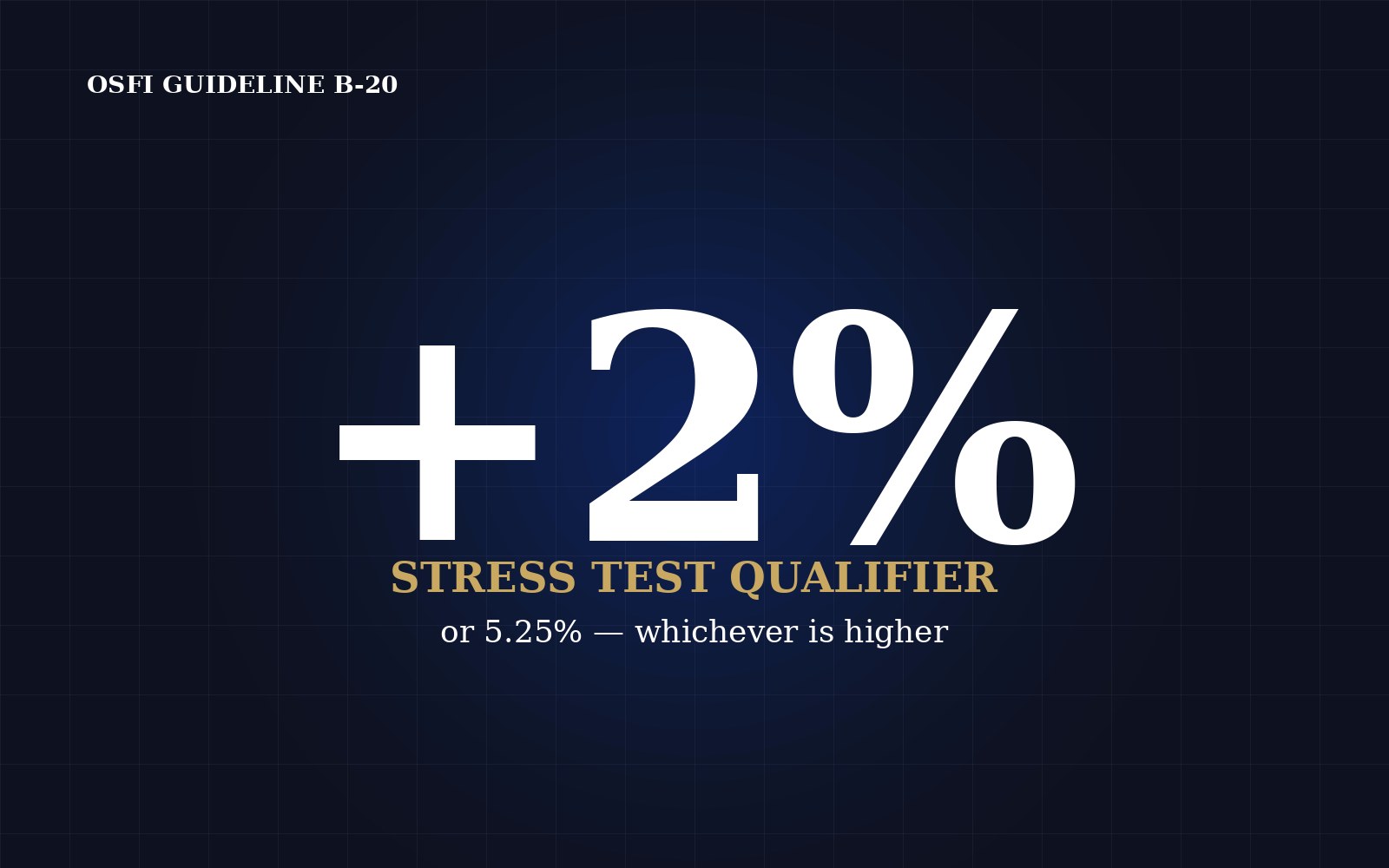
Canada's mortgage stress test, formally Guideline B-20, requires every federally regulated lender to qualify borrowers at the greater of their contract rate plus 2% or the federal qualifying rate (currently 5.25%). It's been in place since 2018, and it's still the single biggest constraint on what you can afford.
Real numbers
A household with $150,000 of qualifying income, no other debt, and 20% down can afford roughly $735,000 in purchase price at a 4.5% contract rate—but only $640,000 once stress-tested at 6.5%. That gap is the stress test's effect on your file.
Workarounds that actually work
- Pay down revolving debt first. Eliminating $20K of credit card balances often unlocks $80K+ of additional purchase power.
- Lengthen amortization. Moving from 25 to 30 years reduces qualifying payment and bumps approved purchase price meaningfully.
- Provincial credit unions. Provincially regulated credit unions don't apply the federal stress test the same way—real option for borderline files.
- Co-signer / guarantor. A high-income family co-signer is the most direct path. We structure these often.
What's changing in 2026
OSFI is reviewing the qualifying rate methodology. No formal change is expected this year, but watch the autumn announcement window. We'll post here if anything moves.
Have questions about how this affects you? Streamline Mortgages reviews every client's file in light of current market conditions. Get a free strategy call →